


The Case for Cash: Emergency Funds, Sinking Funds, and Liquidity Risk
Many investors dislike holding more than a minimal amount of cash. I understand the concern. Over long periods, cash usually earns less than stocks. Even a high-interest savings account may not keep pace with inflation after taxes. If a household has a long time horizon, a high tolerance for risk, and access to credit, it can seem inefficient to leave a meaningful amount of money sitting outside the investment portfolio.
That argument has merit. Holding too much cash can reduce long-term wealth. Some households hold large cash balances because they are reluctant to invest at all, not because they have carefully estimated their need for liquidity.
But the argument can also be incomplete. It sometimes assumes that every dollar not needed this month is truly long-term investment capital. In real household finances, that is often not the case.
The issue is not whether stocks are good long-term investments. For many households, they are. The issue is whether all available money should be exposed to market risk when life can create short-term cash needs at inconvenient times.
Emergency Funds, Sinking Funds, and Liquidity Risk
It helps to distinguish between three related ideas.
Emergency Fund
An emergency fund is money set aside for genuine disruptions. These might include a job loss, illness, disability, an urgent home repair, or an unexpected family situation.
Sinking Fund
A sinking fund is different. It is money set aside for expenses that are irregular but not truly surprising. Cars need repairs. Eventually, they also need to be replaced. Homes need maintenance. Furnaces, roofs, appliances, dental bills, insurance premiums, and property taxes should not surprise us, even if the exact amount and timing are uncertain.
For retirees, the related idea is often a cash wedge, spending reserve, or short-term withdrawal bucket. This is not quite the same as an emergency fund. It is a source of planned liquidity, designed to support regular withdrawals and reduce the pressure to sell equities during a market downturn.
Liquidity Risk
The broader issue is liquidity risk. Liquidity risk is the risk of needing money before it is convenient, tax-efficient, or emotionally tolerable to raise it. It may show up as selling equities after markets have fallen, withdrawing from an RRSP during working years, triggering taxable capital gains at an awkward time, or relying on credit when repayment is uncertain.
In that sense, cash is not always lazy money. Sometimes it is risk management.
The Unexamined Risk of Being Fully Invested
A household does not experience risk only as portfolio volatility. It experiences risk as disruption.
The car breaks down. The roof leaks. A parent needs care. An adult child needs help. Employment income falls. A business slows down. And sometimes these things happen when the investment portfolio is already under pressure.
This is where the simple “stocks for the long run” argument can become too simple. The danger is not just that stocks decline. The danger is that the household needs to sell while they are down. A temporary market decline can become a permanent setback if investments must be sold to fund short-term needs.
A reasonable cash reserve can help avoid that outcome. It may reduce reliance on credit cards, payday loans, or unplanned withdrawals from registered accounts. It may also help investors stay invested with the rest of the portfolio. This behavioural value is easy to underestimate. If a cash reserve helps a household avoid panic selling, it may support long-term investing rather than compete with it.
Patrick Adams’ Useful Challenge
Patrick Adams, a PhD student at MIT, has recently challenged some of the conventional thinking around long-term stock investing. His work, discussed on the Rational Reminder podcast, examines how stock crashes matter when households face income risk, fixed spending commitments, and liquidity constraints.
The basic point is straightforward. Some investors can wait out a market decline. Others cannot. If employment income or business income falls at the same time that markets decline, the household may be forced to draw down liquid assets or sell investments. That risk is especially important for households with large fixed expenses, such as mortgage payments, childcare costs, car payments, insurance premiums, and other commitments that cannot be quickly reduced.
In that context, fixed expenses can operate like a kind of hidden leverage. They reduce flexibility. Even a wealthy household can be fragile if most of its wealth is illiquid and its monthly spending cannot easily be adjusted.
Adams’ research is based on U.S. data, so it should not be applied mechanically to Canadians. Canada has Employment Insurance, CPP, OAS, TFSAs, RRSPs, and different credit and tax structures. But the broad planning insight still applies. Before deciding how much risk to take in a portfolio, a household should first ask how much liquidity it needs to avoid becoming a forced seller.
Working Households and Retired Households are Different
This issue looks different for working-age households than it does for debt-free retirees.
Working Households
For working households, the main risks often involve income interruption and fixed expenses. Job loss, reduced hours, commission income, seasonal work, business downturns, illness, disability, mortgage or rent obligations, childcare costs, car dependence, and debt payments all affect how much liquidity is prudent.
For these households, an emergency fund is mainly about income replacement and shock absorption. A useful structure might include three layers.
First, a monthly cash-flow buffer in chequing or savings accounts can prevent ordinary timing problems.
Second, sinking funds can be used for predictable but irregular costs, such as vehicle repairs, vehicle replacement, home maintenance, or annual premiums.
Third, a true emergency fund can be reserved for larger disruptions, especially job loss or other forms of income interruption.
The common rule of thumb is 3 to 6 months of expenses, but that should not be treated as precise. A stable dual-income household with low fixed expenses may need less. A single-income household, business owner, commission-based worker, household with dependants, or household with a large mortgage may need more. A high-income household with high fixed expenses may be less secure than it appears.
Retired Households
For debt-free retirees over age 65, the question is different. A retired household with no mortgage, no debt, stable CPP and OAS, and perhaps a workplace pension or annuity is not exposed to job-loss risk in the same way. The classic emergency fund may be less important than a well-designed liquidity strategy.
Retirees still need liquidity, but often for different reasons: home repairs, car replacement, health costs not fully covered, family support, long-term care, and portfolio withdrawals during market downturns. For retirees who depend heavily on portfolio withdrawals, a cash reserve or short-term fixed-income reserve may help reduce the pressure to sell equities at poor times.
Some debt-free retirees with substantial assets may be able to hold a meaningful equity allocation, especially if essential spending is covered by secure income and discretionary spending can be reduced. But this does not eliminate the need for liquidity. It changes the purpose of liquidity.
Emergency Fund or Sinking Fund?
The distinction matters. If every irregular expense is treated as an emergency, the emergency fund will be constantly depleted.
Car repairs are not predictable in exact timing, but they are predictable in principle. A vehicle maintenance fund may make more sense than raiding the emergency fund. Car replacement is usually not an emergency unless there has been a major accident or unexpected failure. A paid-off home is not a no-cost home. Home maintenance deserves its own planning category.
For retirees, a market downturn during retirement should not be treated as an emergency if the withdrawal strategy has anticipated it. That is the purpose of a spending reserve or cash wedge.
Where should the money be held?
The best location depends on the job of the money.
A non-registered savings account is simple and flexible, though interest income is taxable. A TFSA can work if there is no better option, but using TFSA room for cash may sacrifice long-term tax-free growth. RRSPs are generally poor emergency fund vehicles during working years because withdrawals are taxable and contribution room is not restored. A HELOC can be useful as a backup, but credit is not the same as cash. Borrowing capacity and repayment ability can become less reliable when income is already under stress. Financial institutions may also choose to reduce their risks and revoke the HELOC.
GICs, high-interest savings accounts, and short-term bond funds can all have a role, depending on timing, tax situation, and need for access. The point is not that all liquidity must be held as cash. The point is that money needed in the near term should not be forced to behave like long-term investment capital.
For more information on emergency funds, the Financial Consumer Agency of Canada (FCAC) offers some helpful tips here: Setting Up an Emergency Fund.
A Balanced Approach
The goal is not to hold as much cash as possible. Nor is it to keep every dollar exposed to the market in pursuit of higher expected returns. The goal is to match the job of the money with the right account, asset, and time horizon.
For working households, emergency funds and sinking funds help protect against income shocks, fixed expenses, high-cost debt, and forced selling. For debt-free retirees, liquidity serves a different purpose: supporting withdrawals, absorbing irregular expenses, and reducing the pressure to sell equities at the wrong time.
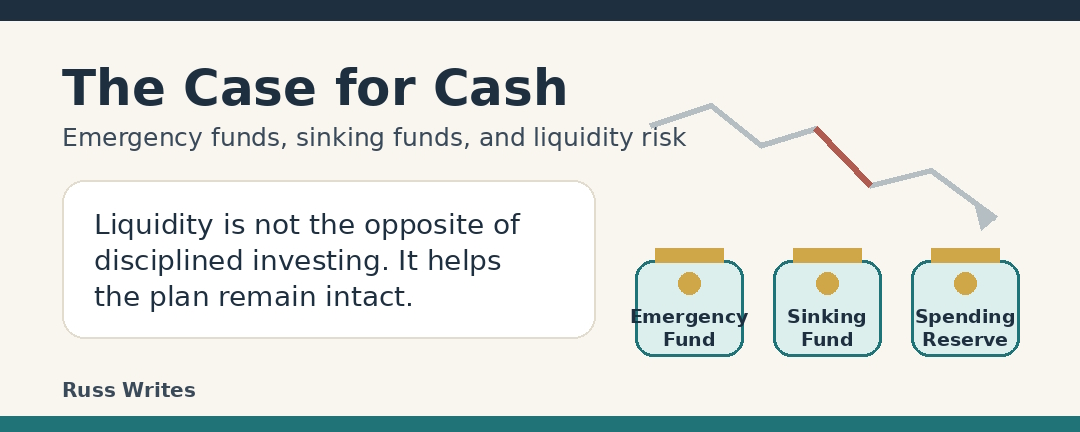
In both cases, liquidity is not the opposite of disciplined investing. Effectively used, it is one of the things that helps the investment plan remain intact.
This is the 311th blog post for Russ Writes, first published on 2026-06-22.
If you would like to discuss this or other posts, connect on Facebook, Twitter aka X, LinkedIn, Instagram, Mastodon, or Bluesky.
If you are an existing client, please contact me by email for an appointment.
If you are a potential new client seeking an advice-only financial planner, I am preparing for retirement and am no longer accepting new clients. Please go to the Advice-Only Planners website. All members listed are also members of the Financial Planning Association of Canada.
Disclaimer: This blog post is intended for general information and discussion purposes only. It should not be relied upon for investment, insurance, tax, or legal decisions.
Image created by ChatGPT