
Russ Writes

Lump-Sum Investing vs. Dollar-Cost Averaging: Revisited

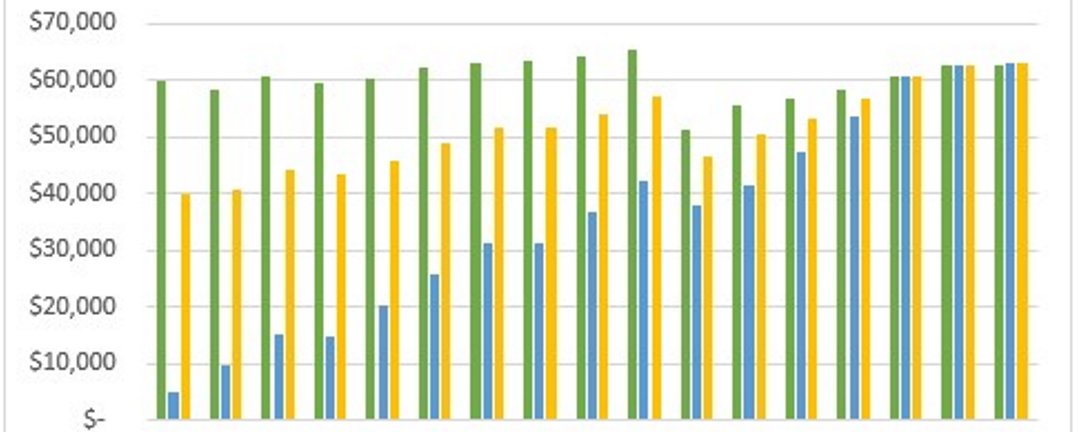
Recapping the Earlier Post Earlier this month (July 2020) I compared the one-year return of the Vanguard Growth ETF Portfolio (VGRO) ending 2020-07-13 using a lump-sum investing approach versus a dollar-cost averaging approach. I invested a $60,000 inheritance in a TFSA in a single lump sum in mid-July 2019, reinvesting the distributions each quarter. I contrasted that with a dollar-cost...
When should I begin taking CPP?

It is the nature of my profession that I read a lot about personal financial matters. One of the most difficult of such matters has to do with retirement. Financial economists will say that retirement planning is difficult because there are so many variables, or as I might say it, there are a lot of moving parts. Chief among those moving parts is one’s lifespan. How long am I going to live? The...

Lump-Sum Investing vs. Dollar-Cost Averaging

The Situation A relative of yours has died. You have received an inheritance. With that money, you have paid off your mortgage and your car loan. You have topped up your Registered Retirement Savings Plan (RRSP) and you have set aside six months of living expenses in an emergency fund. Until now you have never had enough extra money to contribute to your Tax-Free Savings Account. Now you have...

Selecting a Mutual Fund

Using a Screener Mutual funds play a dominant role in Canadians’ investing lives. Even for the self-directed investor, that is, someone who does not have an investment advisor recommending particular investments and who could therefore choose to invest in individual stocks, mutual funds continue to be attractive because of their relative simplicity to purchase. They also allow you to...

Is your investment advisor legitimate?

Sources for checking on an advisor’s registration and disciplinary history I am a big fan of the combination of Do-It-Yourself (DIY) investing with Advice-Only, Fee-for-Service financial planning. I think it can be a cost-effective combination for many. On the other hand, there are many people who do not want to be responsible for their own investments. Reasons vary. Some feel they may not have...

The Role of the Executor

An Introduction to Estate Planning – Part 5 Once you die perhaps the most obvious observation one can make is that you are no longer in charge. The only way to establish some degree of control over what happens to your assets, your estate, is to create a will. A will, as the name makes clear, puts your will – your intentions, wishes, choices, instructions, etc. – in writing in a legally approved...

Charitable Giving

An Introduction to Estate Planning – Part 4 I read about a well-off senior couple who had four children. They decided to “adopt a fifth child” for estate planning purposes. This meant that, in their will, instead of distributing their assets four ways equally among their children, they added charitable giving as their fifth child and split their assets five ways. Charitable giving was a regular...

Children: Trusts and RESPs

AN INTRODUCTION TO ESTATE PLANNING – PART 3.2 In my last post, I discussed the importance of naming a guardian in your will, someone who will take care of your children if you die before they are old enough to take care of themselves. Another item you should consider if your children are young is the management of the financial assets you leave to them after you are gone. Imagine you and your...

CHILDREN: GUARDIANSHIP

AN INTRODUCTION TO ESTATE PLANNING – PART 3.1 When people get around to making a will, they often think of their family first. If they are married, they will think of their spouse first. Some assets can be inherited directly, outside of the will. Here I am thinking of joint bank accounts where both you and your spouse are named, or registered plans like RRSPs or TFSAs, where the spouse can be...

Power to the People: What is a Power of Attorney?

An Introduction to Estate Planning – Part 2 A will, as I think most of us are aware, takes effect once we die. A power of attorney document is in effect while we are alive and ceases once we die. They do not overlap, even though the person who holds power of attorney may also be the executor of your will.   If you go to a lawyer to prepare a will, if your lawyer has done a good job, you will...